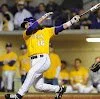
In 338 professional pitchers, the order in which the body's segments fired mattered more for velocity than any single fast segment. Driving velocity with the arm alone came with higher shoulder and elbow loads. A firm, extending lead knee added velocity without that cost.
- Journal
- J Shoulder Elbow Surg
- Published
- 2025
- Design
- 3D motion capture, 480 Hz
- Pitchers
- 338 professional
- My role
- Coauthor
The question
Velocity is built through the kinetic chain: legs, pelvis, trunk, shoulder, elbow, in order. Individual joint speeds have been tied to both velocity and arm stress. We asked what happens when a pitcher is especially fast at one link, and whether the order of the chain changes the answer.
What we did
Professional pitchers threw 8 to 12 fastballs each under 3D motion capture. Pitches were grouped by whether the segments fired in the ideal sequence and by which joint or segment velocities were in the fastest group, then compared for ball velocity and the forces on the throwing arm.
What we found
- Only 71 pitches, from 19 pitchers, were in ideal sequence order, compared with 3,685 pitches in non-ideal order. Ideal sequencing is uncommon even at the professional level.
- Pitches in ideal order were faster: 39.0 versus 38.2 meters per second, about 87.2 versus 85.5 mph.
- Regardless of sequence, pitches in the fastest lead knee extension group had higher ball velocity than the population.
- Faster shoulder internal rotation came with more force on the arm. In ideal-order pitches, a large increase in shoulder internal rotation velocity raised elbow medial force by 5.33% of body weight, elbow distraction force by 9.33%, and shoulder superior force by 4.29%.
What it means for pitchers
Velocity built from the ground up costs the arm less than velocity forced through the arm. For a pitcher whose sequence is not ideal, the lead leg is the safest place to look for velocity: a lead knee that firms up and extends adds speed without adding load on the elbow. Chasing more arm speed in the same situation raised the forces on the shoulder and elbow.
This was a laboratory study of fastballs and did not measure injuries. It describes forces associated with injury risk, not injuries themselves.
Citation
- Manzi JE, Fury M, Dowling B, Estrada J, McElheny K, Carr JB, et al. A comparison of throwing arm kinetics and ball velocity in professional baseball pitchers with the fastest maximum joint and segment velocities. J Shoulder Elbow Surg. 2025;34(7):1751-1761. doi:10.1016/j.jse.2024.10.009 · PubMed 39694228
Matthew S. Fury, MD, FAAOS, FAANA is a board-certified orthopaedic surgeon at the Baton Rouge Orthopaedic Clinic and team physician for LSU Athletics, specializing in sports injuries of the shoulder, elbow, and knee. He trained in the Harvard Combined Orthopaedic Residency Program and completed his sports medicine fellowship at the Hospital for Special Surgery, and he holds subspecialty certification in Orthopaedic Sports Medicine.
Read how I evaluate and treat UCL injuries in baseball players.
Baseball UCL injuries and surgery